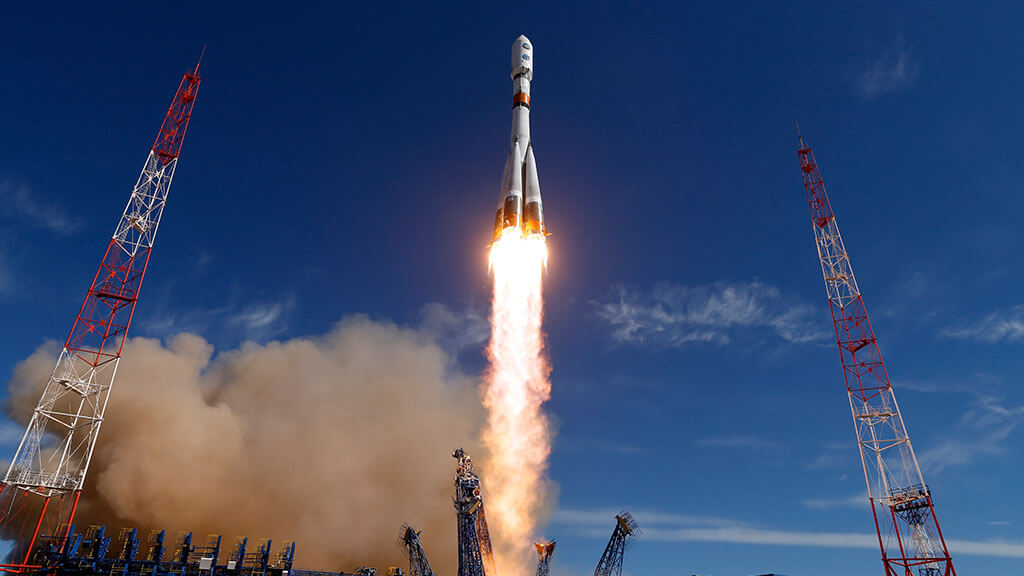
Roskosmos reported that the launch of the launch vehicle was in normal mode, after which the missile's head part separated from the third stage at the set time. The rocket carried into space the satellite "Meteor-M" No. 2-1 and 18 more devices of the associated load.
The main load of this rocket was "Meteor-M" No. 2-1, the device of the "Meteor-3M" space complex developed at VNIIEM corporation. Its weight is 2.9 tons. The device will work in orbit for the next five years, where it will collect operational hydrometeorological information for weather forecasts, monitoring of the ozone layer and radiation situation in near-Earth space. In addition, after reaching the given orbit, it must monitor the sea surface and monitor the ice conditions from an altitude of about 820 kilometers. According to calculations, the "Meteor-M" satellite was supposed to separate at 9:32 Moscow time and start transmitting telemetry, but this has not happened yet.
In addition to Meteor, 18 small spacecraft went to orbit, including the Russian Baumanets-2, the Canadian LEO Vantage, the Norwegian AISSat-Z, the Japanese IDEA, the Swedish satellites SEAM, two American Landmapper-BCs, 10 LEMUR satellites, also owned by the United States and another German D-Star One.
The last of the satellites should be put into orbit around 12:54 Moscow time, after which the upper stage will enter the atmosphere of the planet and burn. All that remains of it, sunk in the Pacific about 14 hours on Moscow time.
This launch was the second in the history launch of the launch vehicle, carried out from the new spaceport Vostochny. The first launch took place on April 28 last year - then the carrier rocket Soyuz was able to launch only from the second time.
The article is based on materials .
Comments
Post a Comment